
Mortgage Business Intelligence
Mortgage Pull-Through Rate Analysis
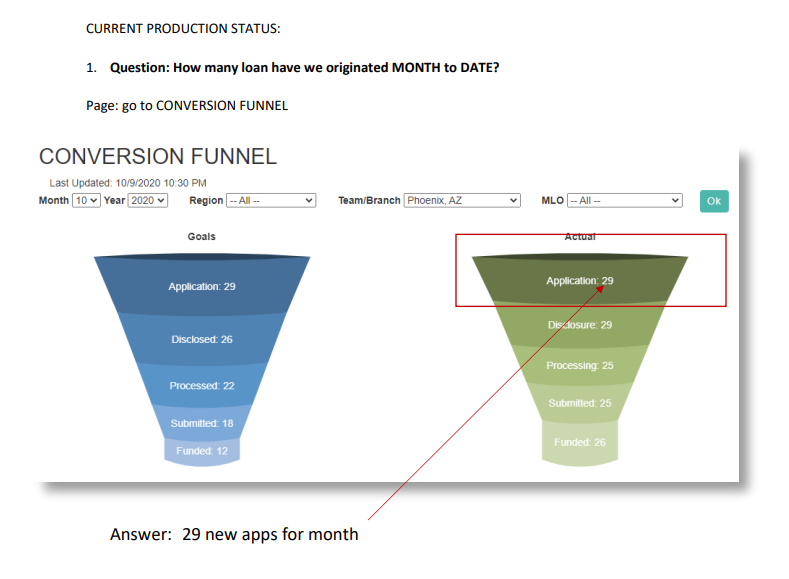
Pull-through is the share of a defined starting population, such as applications, that becomes funded loans. Fallout is the share that does not. The rate is only comparable when the start status, end status, and time window stay fixed.
| What to know |
|
|---|
Pull-through connects applications to funded loans
Pull-through rate is the share of applications, or another defined starting population, that funds. Fallout is the share that does not. A lender can have a large pipeline and a weak funding outlook if too many of those loans are unlikely to close.
Define the population before comparing it
A rate is not comparable until the start status, end status, and time window are fixed. Application-to-funded, lock-to-funded, and approval-to-funded answer different questions. Stage and reason also matter: a withdrawal before underwriting is not the same operating problem as a denial or a file that expires after clear to close.
| Measure | What it helps explain |
|---|---|
| Pull-through | How much starting volume becomes funded loans. |
| Fallout by stage and reason | Where and why loans leave the pipeline. |
| Cycle time | Whether delay may be contributing to fallout. |
How this appears in Telemetry BI
The Mortgage BI product describes pull-through from application to funded loan, fallout by stage and reason, and pipeline-health views that include pull-through and fallout analysis. Those measures are calculated from LOS data rather than from a separate KPI spreadsheet. Predictive pull-through is also described as a model that scores pipeline loans from historical conversion patterns. That is a forecasting aid, not a promise that every scored loan will fund.
See pipeline analytics and production analytics.
More from this category: Mortgage Business Intelligence articles.